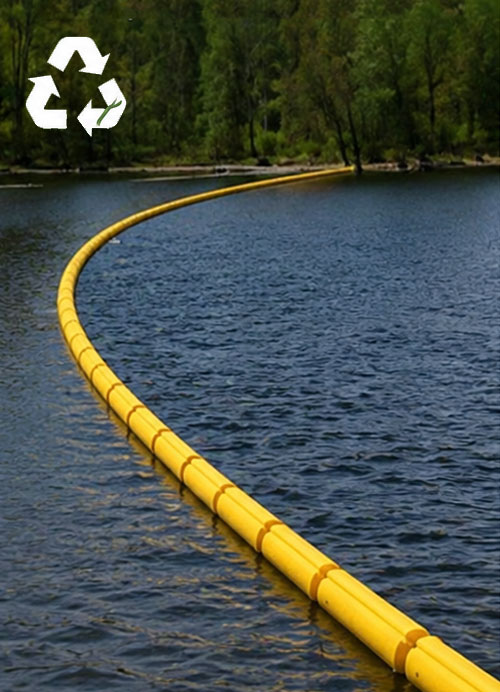
A floating trash boom is a surface-mounted barrier deployed across waterways to intercept, concentrate, and retain floating debris. It traps leaves, logs, seaweed, plastic and other floating waste in rivers, lakes, canals and coastal areas: current and wind carry rubbish into the barrier, which holds it in a dense, easy-to-collect patch while water flows freely underneath.
You can think of it like a heavy-duty pool noodle strung across a stream: it stops floating litter, and water passes beneath. Real-world performance depends on component design, anchoring engineering, site conditions and ongoing maintenance. This guide breaks down exactly how these systems work, what parts they include, and what drives long-term capture efficiency.
Key Takeaways
- A floating trash boom uses buoyant floats, a submerged skirt and connecting joints to trap surface debris while letting water flow underneath.
- It gathers scattered litter into one concentrated zone, drastically reducing cleanup time and labor for field crews.
- Proper siting and engineered anchoring are the biggest factors in reliable performance across changing current, wind and tidal conditions.
- Flow speed, wind force and debris type all determine capture efficiency and required structural strength.
- Routine inspection and timely debris removal prevent overload and extend the boom’s service life.
What Is a Floating Trash Boom?
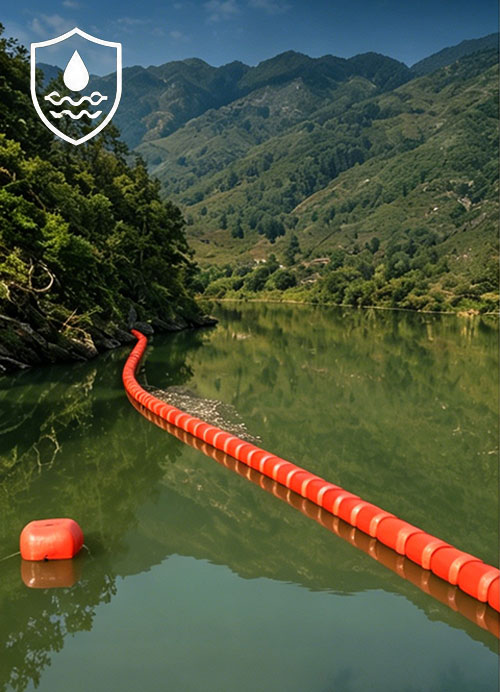
A floating trash boom sits at the waterline and performs three core functions: stays afloat, blocks debris, and allows water to pass through.
- Freeboard: the section above the water surface that stops trash from washing over the top.
- Skirt: the flexible curtain hanging below the waterline that catches submerged floating debris without fully blocking the water column.
The short skirt depth leaves plenty of open space underwater, so fish and other aquatic life can swim beneath the barrier unobstructed.
Core Components
Every complete floating trash boom system is built from a standard set of modular parts:
- Floats: Provide buoyancy and stability, typically cylindrical or multi-chamber designs. High-quality units use a rotomolded LLDPE outer shell filled with closed-cell polyurethane foam, which remains unsinkable even if the outer shell is punctured.
- Skirt: Vertical flexible barrier hanging below the waterline to stop debris from slipping under.
- Tension backbone: Internal steel cable or polyester rope that bears the full pulling load of current and debris buildup. Heavy-duty models use a hot-dip galvanized steel reinforcement for high tensile strength and impact resistance.
- Multi-axis connectors: Join individual boom segments, flexing to follow wave movement and reduce tearing stress on anchor points.
- Accessories: Tidal compensators, anchoring kits, marker buoys, towing bridles and warning lights for installation, adjustment and visibility.
Premium designs use a 4:6 freeboard-to-draft ratio to prevent debris from slipping underneath in fast flow, paired with a low-drag hydrodynamic profile to reduce water resistance.
How Does a Floating Trash Boom Capture Debris?
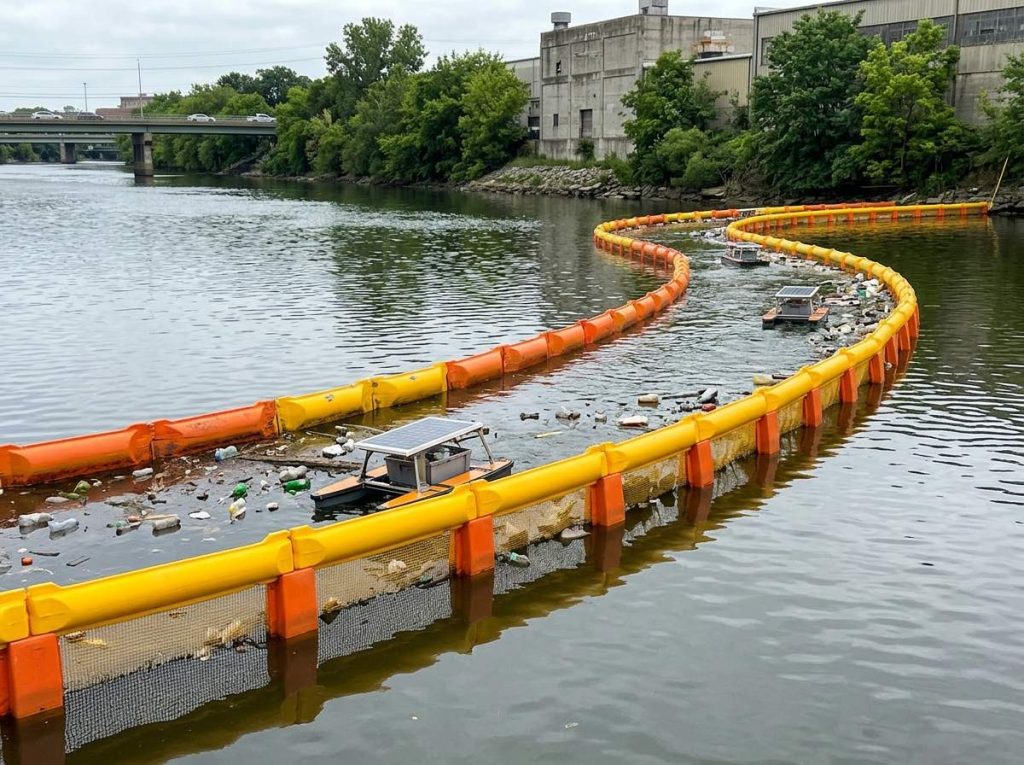
The boom works in two sequential stages: interception/concentration, and retention.
1. Interception & Concentration
When floating debris carried by current or wind hits the barrier, its downstream movement stops. Ongoing flow pushes more litter along the boom line, gradually gathering loose scattered waste into a single dense, scoopable patch.
There are several field-proven configurations for different sites:
- U-shaped barrier: Used at small river mouths, it traps trash and holds it for removal.
- Dual-boom setup: An upstream primary boom takes the main load; a secondary downstream boom catches any escaped waste during heavy buildup events.
- No-return guard boom: Installed alongside the main barrier to stop collected trash from drifting back upstream.
2. Retention Until Collection
The barrier holds accumulated debris continuously between cleanup runs. The EPA classifies these systems as floating structures with hanging curtains designed to capture floatable materials downstream of stormwater outfalls.
This concentrated retention drastically reduces cleanup cost: crews do not need to chase scattered litter across open water — they only harvest waste from one compact zone. Booms can also be used to divert floating rubbish away from sensitive assets such as hydropower intakes, harbors and estuary habitats.
What Affects Floating Trash Boom Performance?
Factors That Determine Performance
Four main variables dictate how well a boom performs at a given site:
- Current, wind and waves: Fast flow creates high drag; large logs deliver sharp impact loads; thick floating vegetation adds heavy accumulated mass.
- Debris characteristics: Small plastic fragments, heavy timber and matted aquatic weeds all create different capture challenges and structural loads.
- Silt and sediment: In high-turbidity sites, silt can build up on the skirt and reduce effective draft. Self-cleaning tapered profiles help shed sediment automatically.
- Engineering and build quality: Below are typical performance specifications for a heavy-duty industrial boom (Botai reference design):
| Performance Factor | Rated Specification |
|---|---|
| Continuous tensile load | 25-ton limit via internal galvanized steel backbone |
| Debris impact resistance | Absorbs 120 kJ impact (equivalent to 2-ton log at peak flood velocity) |
| Accumulation capacity | Up to 1.2 tons of wet waste per linear meter |
| Wind / wave resistance | Withstands 1.8 m wake waves and 45-knot crosswinds without capsizing |
| Wave-following efficiency | 98% flexibility compliance, reducing anchor tear stress by over 60% |
| Drag coefficient | Cd = 0.22 hydrodynamic profile for low resistance in fast flow |
| Sediment rejection | Self-cleaning tapered geometry prevents silt buildup and draft loss |
Maintenance & Best Practices
Regular upkeep keeps a boom working reliably long-term:
- Inspect connectors, anchors and skirt condition on a scheduled basis.
- Remove accumulated debris before it overloads the structure.
- Check draft depth in silty water to confirm sediment has not reduced effective skirt height.
- Adjust inspection frequency seasonally as flow, tide and debris volume change.
For best results, plan the debris collection workflow before installation, so crews have a clear process for emptying the boom before overload occurs.
FAQ
Does a floating trash boom block fish and aquatic wildlife?
No. The skirt only extends a short distance below the surface, with open water flow underneath. It targets floating waste at the waterline and does not block fish or aquatic life moving through the water column.
Will the boom sink if the outer shell is punctured?
Models with closed-cell PU foam cores stay buoyant after punctures. Sealed individual foam cells cannot flood, so the boom remains functional even after impact damage.
Can a boom work in fast currents with heavy logs?
Yes, within its published rating. Heavy-duty steel-reinforced booms are engineered for high tension and log impact, paired with optimized freeboard/draft ratios to stop under-running. Always match the boom grade to your site’s peak flood conditions.
How often do crews need to remove collected trash?
There is no fixed interval — it depends on local debris volume. Timely removal prevents overload and preserves the boom’s designed ability to move with waves and current.
Where do floating trash booms work best?
They perform well in rivers, lakes, canals, harbors and upstream of water intakes. Siting is the biggest performance variable: anchor geometry, boom angle and routine upkeep matter more than raw boom size alone.