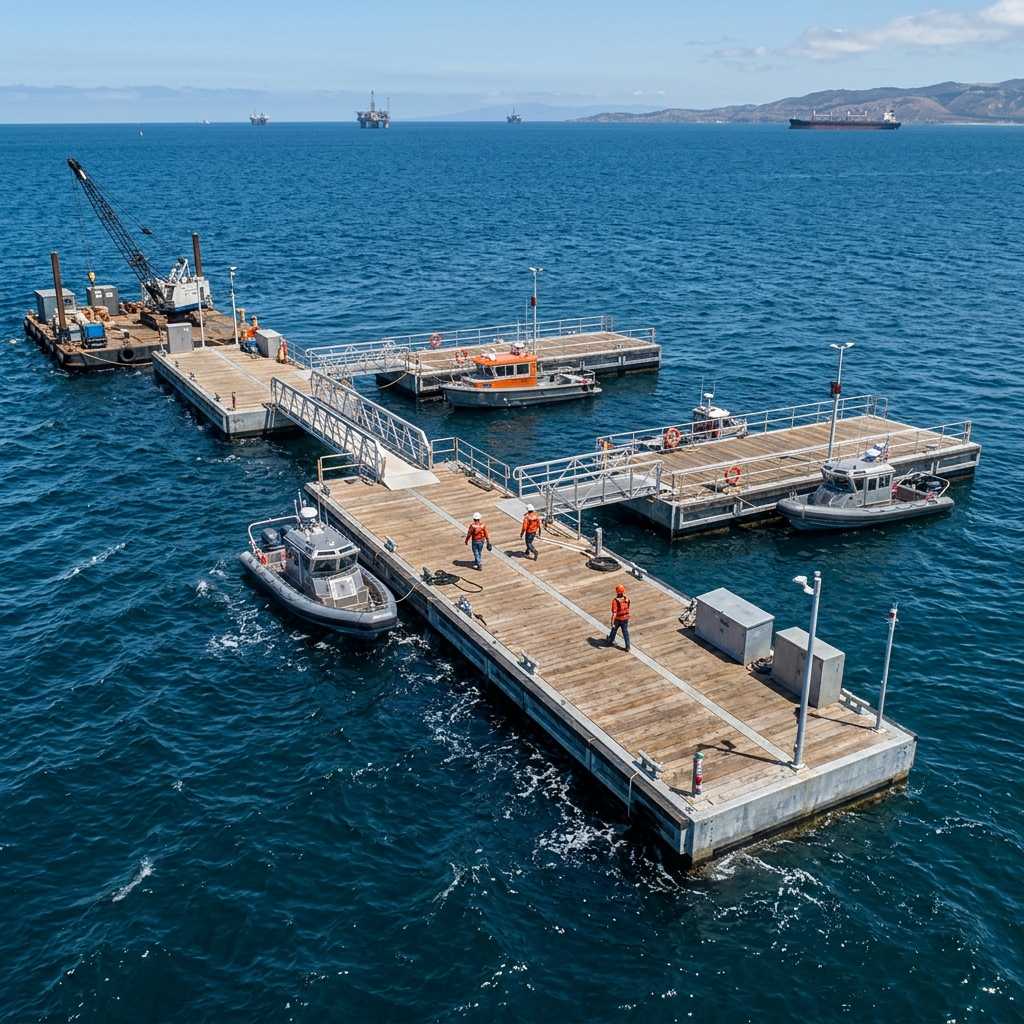
A floating jetty operates on the core principle of buoyancy: sealed hollow pontoons displace water to create upward lifting force, supporting a flat, usable deck above the water surface. Anchoring systems hold the structure in place horizontally while allowing it to rise and fall freely with tides, seasonal water level shifts, and wave action. Modular interlocking sections let owners expand, reconfigure, or relocate the layout as needs change.
In simple terms, a floating dock works much like a boat hull: trapped air inside sealed chambers makes the structure lighter than the water it displaces, so it stays afloat. Three interconnected systems make the design work: flotation pontoons, position anchoring, and modular deck connections. This guide breaks down each part, explains how floating jetties adapt to changing water levels, and covers where they work best.
Key Takeaways
- Floating jetties stay afloat using sealed pontoons that displace water to generate buoyant lift.
- Anchors and guide systems hold the dock in position while letting it move vertically with tides and water level changes.
- Modular interlocking sections can be rearranged or expanded to fit different layouts and uses.
- Floating jetties are ideal for tidal zones, rivers, and reservoirs where water levels rise and fall regularly.
- When selecting a system, match anchoring and materials to site conditions for the best long-term value and durability.
Core Principle: Buoyancy & Pontoon Flotation
All floating docks rely on Archimedes’ principle: the upward buoyant force equals the weight of the water displaced by the submerged floats.
For seawater (density ~1,025 kg/m³), every cubic meter of displaced volume generates roughly 1.025 tonnes of lifting capacity. Larger or more numerous pontoons displace more water and support heavier loads. Sealed, air-filled chambers keep water from entering, maintaining consistent buoyancy over time.
High-quality modular systems use seamless rotomolded HDPE (high-density polyethylene) pontoons with uniform wall thickness. For example, Botai floating dock pontoons feature UV-15 stabilized polymer rated for continuous surface temperatures up to +80°C, with 8 mm thick walls. Standard load ratings include 350 kg/m² for boat berths and 380 kg/m² static load for swim and event platforms.
How Floating Jetties Rise & Fall With Water Levels
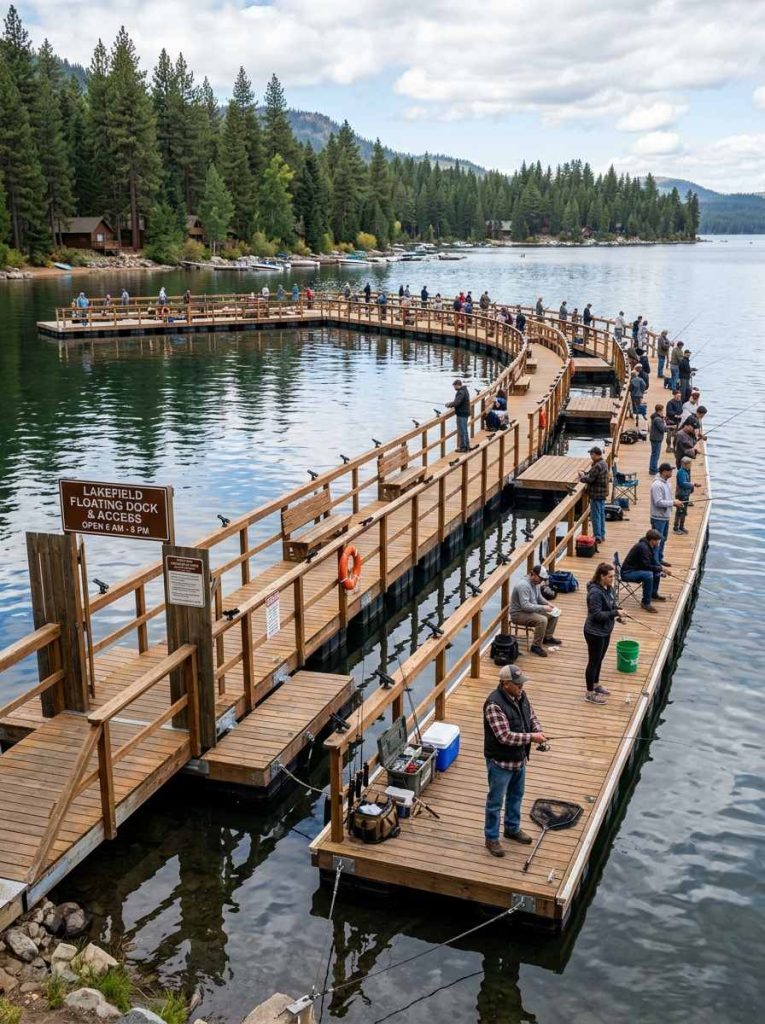
Unlike fixed piers built at a set height, floating docks sit directly on the water surface and move up and down as levels change. This self-adjusting behavior is their biggest advantage over fixed structures.
- Tidal zones: The deck maintains a consistent height above the water surface, so boarding and disembarking from boats stays safe and easy at both high and low tide.
- Rivers & reservoirs: Seasonal rainfall, dam releases, or drought shifts water levels without requiring manual adjustment of the dock.
- No mechanical parts needed: Buoyancy alone handles all vertical movement — no pumps, jacks, or manual resetting required.
This constant freeboard (deck height above water) is the primary reason floating jetties are the standard choice for tidal coastal areas and variable-level inland waters.
How Floating Jetties Stay in Position?
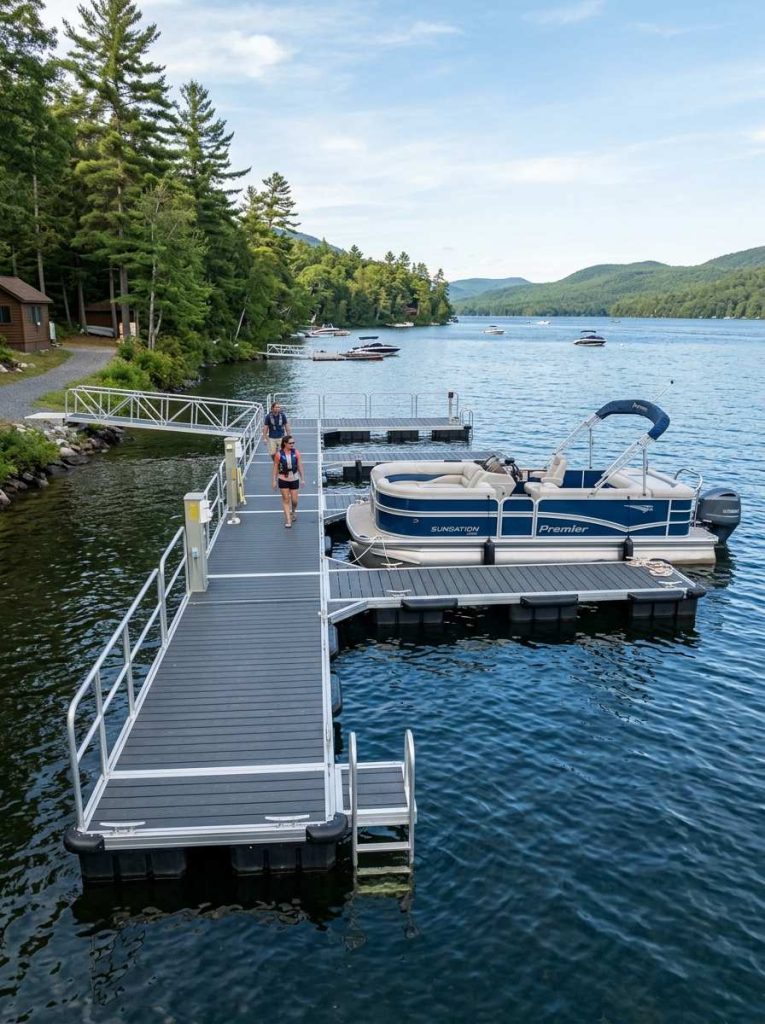
Anchoring Systems
Buoyancy keeps the dock afloat, but an anchoring system stops it from drifting with wind, current, and waves. Three common methods are used, all designed to allow vertical movement while resisting horizontal drift:
- Seabed ground weights Heavy concrete or steel weights rest on the bottom, connected to the dock via chains or ropes. The weights resist sideways movement while slack in the line lets the dock rise and fall. Best for calm, sheltered sites with moderate current.
- Mooring ropes & lines Ropes run from the dock to shore anchors or seabed blocks. Tension can be adjusted to match conditions. This is the most flexible and lowest-cost option for protected waterways.
- Guide piles / pilings Vertical piles are driven into the seabed, and guide brackets on the dock slide up and down along each pile. This provides the strongest lateral hold, making it the preferred choice for fast currents, heavy wave action, and high-traffic marinas.
Sites with stronger conditions require more robust anchoring. Botai floating dock systems are engineered for river currents up to 3.5 m/s, wave heights of 1.5 m, and tidal variations exceeding 5 m.
Shore Connection: Gangways & Ramps
A hinged gangway (ramp) bridges the gap between land and the floating deck. One end pivots on a fixed shore abutment; the other rests on the dock and slides or pivots as the water level rises and falls.
This design keeps the walkway usable and safe across the full tidal range. A rigid fixed walkway would crack, lift, or become dangerously steep during large level changes. The shore connection also absorbs horizontal wind and current loads, transferring them to the onshore abutment.
Modular Floating Jetty Design
Most modern floating jetties are built from interlocking modular cube sections. Heavy-duty lugs lock adjacent units together into a single rigid platform. Individual lugs can resist over 1.8 tons of diagonal pull and have a shear strength of at least 16 MPa, spreading impact and load energy evenly across the structure.
Key advantages of modular design:
- Flexible layouts: Sections can be arranged into T, L, F, or wide platform shapes for marinas, swim areas, or event stages.
- Scalability: Owners can start small and add more sections as needs grow.
- Specialized modules: Purpose-built sections exist for different uses:
- Drive-on jet ski docks with polyurethane rollers (reduces launch friction by 40%, holds craft up to 1,200 kg)
- Fishing docks with 300–400 mm freeboard and accessory mounting points
- Low-profile kayak docks (150–200 mm freeboard) for easy entry
- Swim platforms with anti-slip surfaces and integrated ladders
Where Floating Jetties Work Best
Floating jetties excel in locations with significant water level variation (generally 0.5 m or more). They are not always the cheapest option for stable-level lakes where a fixed pier may be simpler.
Common applications:
- Recreational use: swimming platforms, fishing docks, kayak and boat launches
- Commercial marinas, yacht clubs, and waterfront resorts
- Temporary event platforms for weddings, concerts, or public gatherings
- Public parks, emergency services, and law enforcement water access points
The global floating docks market was valued at USD 0.77 billion in 2025, with leisure and recreation use making up 46% of demand. The market is projected to reach USD 1.12 billion by 2032 at a 5.5% CAGR, driven by marina expansion and waterfront development.
FAQ
What makes a floating dock stable to walk on?
Wide, evenly spaced pontoons create a broad, balanced base. Anti-slip deck surfaces improve traction, and proper anchoring prevents excessive drift or rocking. Larger platforms are inherently more stable than small narrow sections.
Do floating docks work in deep water?
Yes — depth does not change the basic buoyancy principle. Anchoring is the main design consideration: ground weights and mooring lines work for moderate depths, while guide piles provide the strongest hold for deep, fast-flowing sites.
Can floating jetties handle strong currents and waves?
Yes, within engineered limits. Heavy-duty systems with pile guide anchoring handle currents up to 3.5 m/s and 1.5 m wave heights. Always match the anchoring design to actual site conditions.
What are floating dock pontoons made of?
Most modern systems use seamless rotomolded high-density polyethylene (HDPE). Premium pontoons include UV stabilization, thick uniform walls, and fusion-welded fittings for long service life. The material resists corrosion, impact, and freeze-thaw damage.
How much weight can a floating jetty hold?
Load capacity depends on pontoon size and quantity. Standard recreational models support 300–380 kg/m², while heavy-duty commercial systems are sized for higher loads. Always share your expected use with the supplier so they can size flotation correctly.