When people refer to a standard “dock,” they almost always mean a fixed dock: a rigid structure anchored to the shore or lakebed with piles, with a permanent, unchanging deck height. A floating dock rests on sealed, buoyant pontoons and rises and falls with water levels. This core design difference drives nearly every other distinction in stability, installation effort, maintenance, cost, and ideal use case.
Neither design is universally better. Fixed docks deliver firm, stable footing in calm, shallow water. Floating docks adapt to deep water and fluctuating levels. This guide breaks down all key differences to help property owners match the right structure to their shoreline, vessel, and budget.
Key Takeaways
- Fixed docks sit on driven piles and hold a permanent deck height; floating docks rest on pontoons and move with the water surface.
- Floating docks excel in deep water, soft seabeds, and locations with frequent water level changes.
- Fixed docks feel more solid underfoot and handle heavier point loads better.
- Floating docks keep a consistent boarding height and absorb wave energy, reducing strain on moored boats.
- Base your choice on water depth, shoreline geology, and intended use, and always verify local building regulations before construction.
Core Design Differences Between Fixed Dock vs. Floating Dock
Fixed Docks: Permanent Pile-Supported Structures
A fixed dock is built on vertical piles or columns driven deep into the shore or lakebed. These supports transfer all vertical and lateral loads directly into the soil or rock below, holding the deck at a single permanent elevation regardless of water conditions.
This rigid design requires pile installation across the full length of the structure, which becomes more complex and costly as water depth increases. Installation typically calls for heavy equipment, barges, or cofferdams. Once built, the layout is permanent and difficult to reconfigure. In cold climates, fixed docks must withstand significant horizontal force from expanding ice.
Floating Docks: Buoyant, Modular Systems
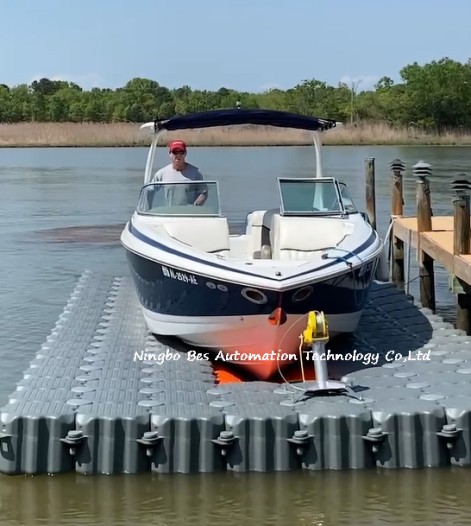
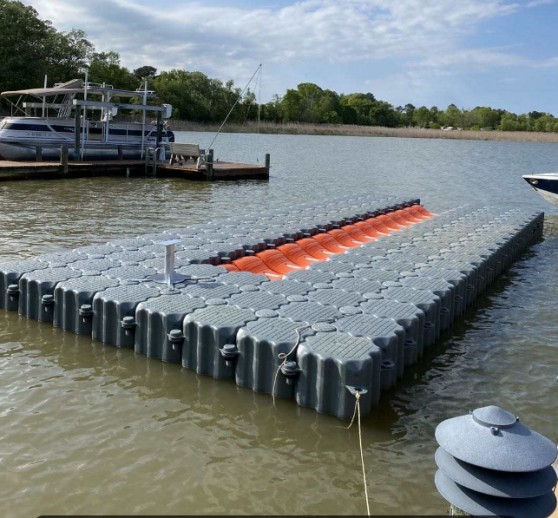
A floating deck is supported by sealed, foam-filled polyethylene pontoons — even a punctured shell will not sink. Total buoyancy is engineered to support the deck weight plus all people and gear on board. The structure rises and falls naturally with water levels, and is held in place by mooring cables, anchors, or guide piles that allow vertical movement while preventing horizontal drift.
Most floating docks come as prefabricated modular sections, making assembly fast and scalable. Anchoring options are matched to site conditions: deadweight anchors for medium-depth lakes, auger anchors for shallow soft beds, and heavy guide pile systems for tidal or high-wave areas. A gangway connects the floating deck to shore, with a slope that adjusts as water levels change.
Side-by-Side Comparison
| Factor | Fixed Dock | Floating Dock |
|---|---|---|
| Construction | Rigid deck on driven piles/columns | Buoyant deck on sealed pontoons |
| Deck elevation | Permanent, fixed height | Rises and falls with water levels |
| Water depth limit | Limited by practical pile installation depth | Works in nearly any depth |
| Layout flexibility | Permanent, hard to modify | Modular; easy to reconfigure or expand |
| Shore access | Direct, level connection | Via gangway with variable slope |
| Best for | Shallow, calm water with stable levels | Deep water, fluctuating levels, soft seabeds |
Terminology note: Dock vs. pier The two terms are often used interchangeably, but have strict definitions: a pier is a long, elevated structure extending from shore into the water, supported by piles. A dock is the berthing area where vessels tie up. In practice, many structures serve both purposes, so the labels often overlap.
Performance Comparison: Fixed Dock vs. Floating Dock

Stability & Load Capacity
Fixed docks are far more rigid underfoot. Their solid foundation handles heavy point loads — such as cranes, fuel stations, or even light vehicle traffic — far better than buoyant designs. The tradeoff is that rigid structures take the full force of waves, surge, and ice directly, which can damage supports over time.
Floating docks trade some firmness for adaptability. Stability depends on module size, pontoon buoyancy, and mooring design; well-engineered commercial systems are robust enough for marinas serving superyachts. Because they move with waves instead of acting as a barrier, they reduce strain on mooring lines, cleats, and boat hulls.
Water Level Fluctuation
This is the most impactful functional difference.
- Fixed docks: Deck height never changes. Large tides, seasonal drawdowns, or reservoir level shifts can leave the deck too high or too low for safe boarding, creating steep, unsafe ramps.
- Floating docks: The deck stays at a consistent height above the water surface. Boarding and launching boats, kayaks, and paddleboards remains safe and easy regardless of tide or seasonal level shifts.
Durability & Maintenance
- Fixed docks: With proper installation, they have an extremely long service life with minimal routine maintenance. The biggest risks are ice damage in cold climates and uneven pile settlement over time.
- Floating docks: Require periodic inspection of pontoons, mooring lines, and connection hardware. In regions with heavy ice, they can often be removed or lifted for winter to avoid damage. Well-built seamless polyethylene pontoons resist punctures and maintain consistent buoyancy for decades.
Which Dock Type Is Right for You?
Site conditions are the biggest deciding factor, not personal preference.
Choose a fixed dock if:
- Water is shallow (typically under 10 feet) with a firm, stable seabed (clay or rock)
- Water levels stay consistent year-round
- You need maximum stability for heavy equipment or frequent foot traffic
- You want a permanent, low-maintenance structure
Choose a floating dock if:
- Water is deep enough to make pile installation impractical or prohibitively expensive
- The seabed is soft, muddy, sandy, or rocky — all conditions that make piling difficult
- Water levels fluctuate significantly (tides, seasonal drawdowns, reservoir changes)
- You want a modular, reconfigurable layout or plan to expand in the future
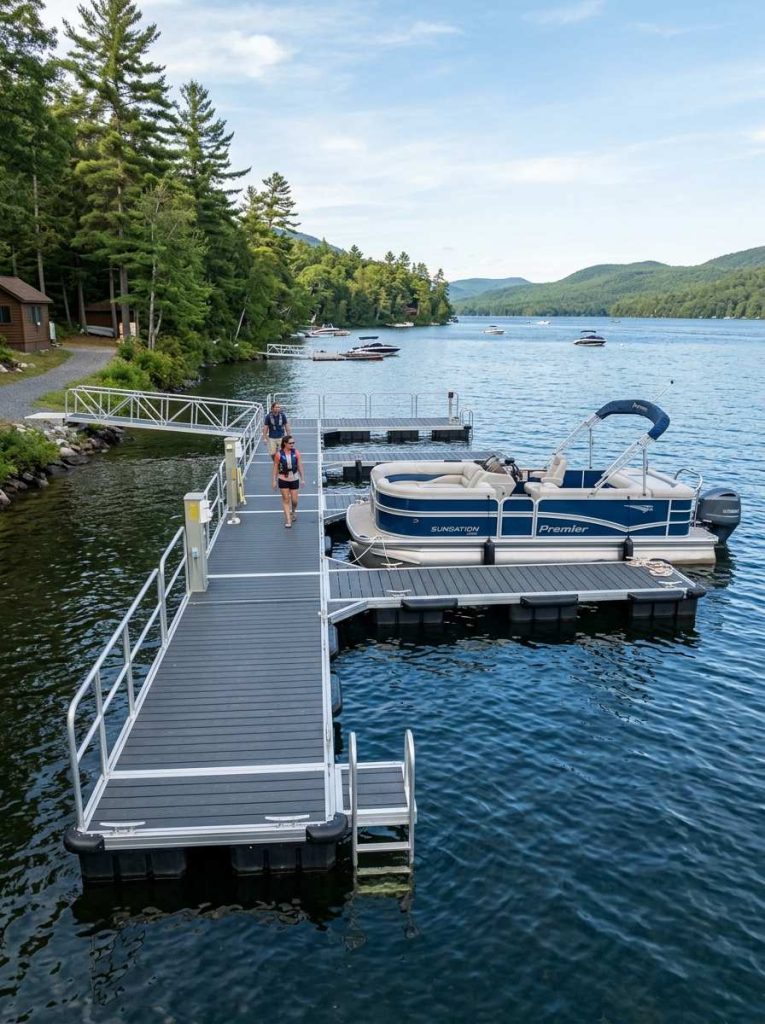
Many properties use a hybrid design: a fixed gangway or main walkway feeding floating berthing slips, combining shore stability with adaptable boat access.
FAQ
What is the main difference between a standard dock and a floating dock?
A standard fixed dock stands on piles driven into the lakebed or shore, with a permanent deck height. A floating dock rests on sealed buoyant pontoons and rises and falls with the water surface.
Do floating docks work well with big water level changes?
Yes. Floating docks automatically adjust to tides, seasonal shifts, and reservoir drawdowns, keeping the deck at a consistent height above the surface for safe boarding. Fixed docks cannot adjust their elevation, so large level swings can make boarding unsafe.
Are floating docks suitable for deep water?
Yes. Water deeper than 10 feet typically makes pile-driven fixed docks impractical or too costly, so floating systems are the standard choice. They also work better on rocky, muddy, or soft sandy seabeds that are hard to drive piles into.
How are modular floating docks assembled?
Modular floating docks come as prefabricated sections that connect together quickly. They are secured in place with mooring cables, anchors, or guide piles. New sections can be added later without modifying existing foundations, making layouts easy to reconfigure.
Can you safely tie a boat to both types of dock?
Yes, when designed and installed correctly for the site. Floating docks maintain a consistent boarding height, which is easier on boats and passengers through tide changes. Fixed docks provide a more solid mooring point in stable water conditions.